
Relational
Well-Being: Practices
Practices to Cultivate Relational Well-Being
This section includes five practices for cultivating your relational well-being.
I encourage you to read through each and consider: Do any of these sound useful or interesting? What would I be willing to try? Think about the ways you want to grow in your relational well-being. As you read through these practices, consider which are resonating with you or seem like they might be helpful.
[Each of the six below is linked to it’s section on this page for quick reference.]
Relational Well-Being:
Positive relationships with others
Social integration
Social acceptance
Social contribution
Social actualization
Social coherence
Practice 1: Dyadic Awareness
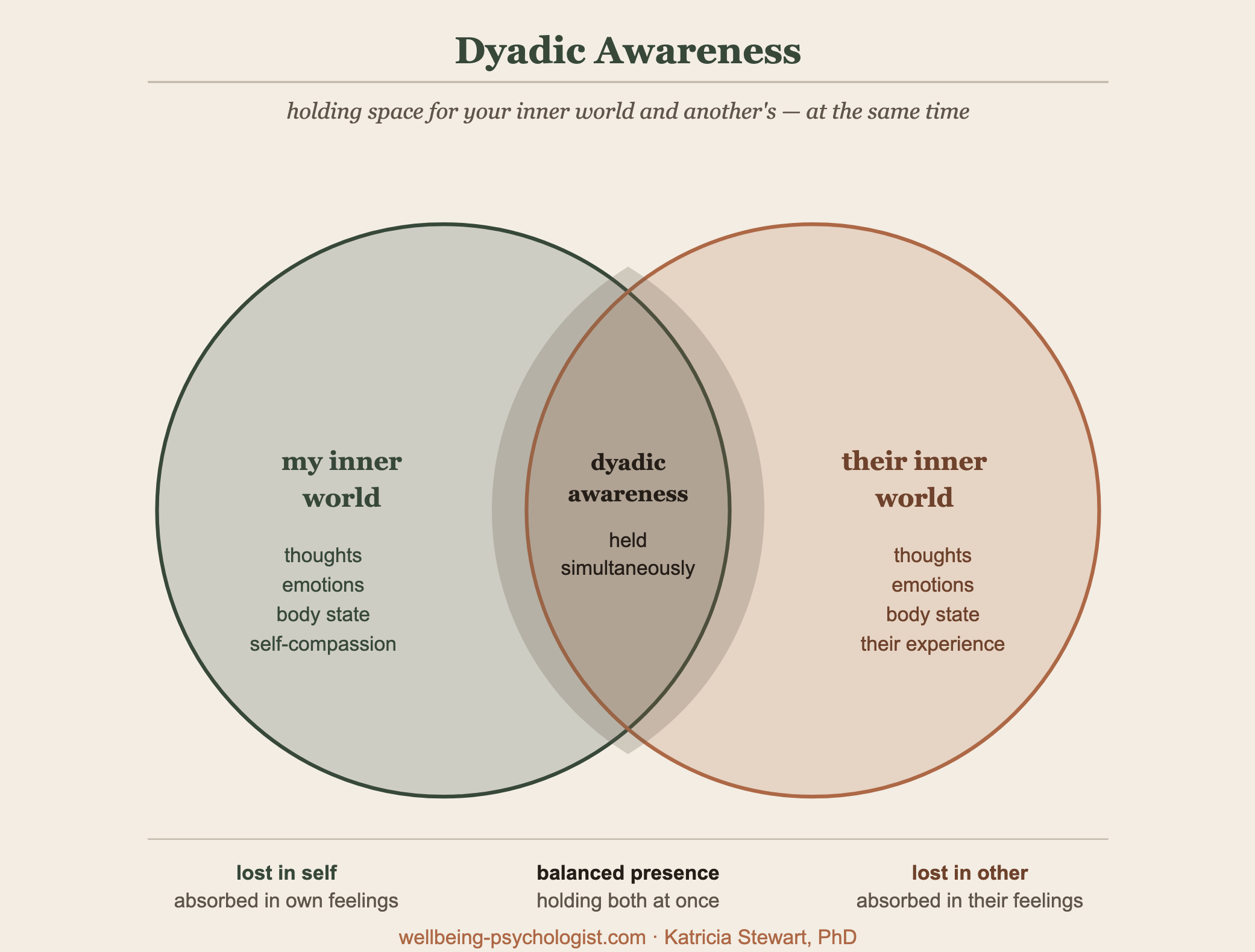
Dyadic awareness is the ability to be aware of our own internal world (e.g., thoughts and emotions) while simultaneously being aware of another person’s internal world.
What is dyadic awareness?
Dyadic awareness is the ability to be aware of our own internal world (e.g., thoughts and emotions) while simultaneously being aware of another person’s internal world. Can you hold space for both your own emotions and another’s emotions at the same time?
Usually, we go back and forth between our own internal worlds and others’. We feel our feelings, then we sense or hear others’ feelings and are absorbed in them, then we come back to our own. Or, we have a thick wall that blocks out others’ feelings when they are too overwhelming or difficult for us to cope with.
This is especially challenging in close relationships, and even more so when someone else’s negative feelings are about or directed towards us.
Why is dyadic awareness important?
Dyadic awareness supports us in holding space for our own emotions and that of another person at the same time. When we are able to hold this fuller picture in mind, we can approach life’s ups and downs with greater compassion, equanimity, and wisdom. When we get too sucked into our own emotions or another person’s emotions, we get pulled off balance, are more easily triggered, and are not able to cultivate the quality of relationships that we truly long for.
Dyadic Awareness Practice
(From Dr. Sara Owens Woodard)
Sit down face-to-face with another person.
Choose who will start as the speaker, and who will start as the listener. (You’ll both get a chance to play each role).
Speaker: The job of the speaker is to share, in detail, both a positive and a negative experience. The speaker will get 5 minutes total: 2.5 for a negative experience, and 2.5 for a positive experience / gratitude (set a timer!).
The speaker should try to share for the full 2.5 minutes for each experience.
Share what the experience was, how it made you feel, how it felt in your body, your thoughts about it, etc.
The speaker should switch to the other experience right at 2.5 minutes, and then should stop right at 5 minutes, even if in the middle of something.
Then you switch roles!
Listener: The job of the listener is to just listen. Don’t say anything, and try not to respond with any physical cues either – no nodding, smiling, anything. Just a neutral body and face while you deeply listen to the other person.
Set the timer for 2.5 minutes, have the speaker share either the positive or negative experience.
At 2.5 minutes, the speaker switches to the other experience (either positive or negative, whichever wasn’t shared yet).
At 5 minutes, the roles switch.
The practice here is mostly for the listener.
The listener’s job is complex.
The listener practices being aware of the other person’s emotions that they’re sharing, and practicing deep empathy and compassion for them.
The listener also practices being aware of their own emotions – how it feels to hear these positive and negative experiences that the other person is sharing.
The listener tries to go back and forth between feeling with the other person, and feeling their own feelings. Eventually, you get really close to holding both at the same time. Being able to hold both at the same time is dyadic awareness.
Guidelines & Suggestions
Sit quietly if the words stop before the time does. And if the time is up before the words are, switch anyway.
The Listener should only listen. No head nods, no verbal affirmations, no comforting, no physical touch. The objective is to be fully, totally present to the other person’s experience and to your own.
Notice your body state. Start here, with body awareness.
How does it feel in your body to be speaking, to be listening?
Can you notice your body state at the same time you are speaking or listening?
Over time, with this “noticing,” you will likely find that your internal state becomes calmer, more stable. This provides a more stable “foundation” for deepening your ability to do the next items which are related to noticing where your awareness is, and the quality of your awareness.
This is a right hemisphere process – more non-verbal the “feeling, sense or context” that is going on may or may not sync up with the content of the words. OK to feel a bit lost at first, you are training yourself to get better at tuning into yourself and the other.
Focus on the non-verbal sharing of signals, such as: eye contact, facial expression, tone of voice, gestures and timing and intensity of response. These are the basic vocabulary words of non-verbal communication.
Notice where your awareness is. This is a dyadic practice, meaning the objective is for you to be aware of both yourself and the other. Ideally, over time, you will be able to move your awareness back and forth between yourself and the other, sensing your own state of awareness, and sensing the other person’s. You may even experience being present to both at the same time.
Watch the nature of your awareness.
Are you losing yourself in the other person, and losing awareness of your own state?
Are you lost in your own internal state, and disconnected from the other person?
Are you dissociated, meaning you are checked out or shut down?
Are you moving between two or more of the above states?
Practice 2: Compassion
Researchers define compassion as the feeling that arises when you are confronted with another’s suffering and feel motivated to relieve that suffering. It is characterized by feelings of warmth, concern, and care for the other, as well as a strong motivation to improve the other’s well-being.
Understanding Compassion
Dyadic awareness and compassion can be very intertwined. Dyadic awareness requires empathy, which is part of compassion, and compassion practice can help us get better at dyadic awareness.
Researchers define compassion as the feeling that arises when you are confronted with another’s suffering and feel motivated to relieve that suffering. It is characterized by feelings of warmth, concern, and care for the other, as well as a strong motivation to improve the other’s well-being.
Compassion is different from empathy and altruism, although they are all related concepts.
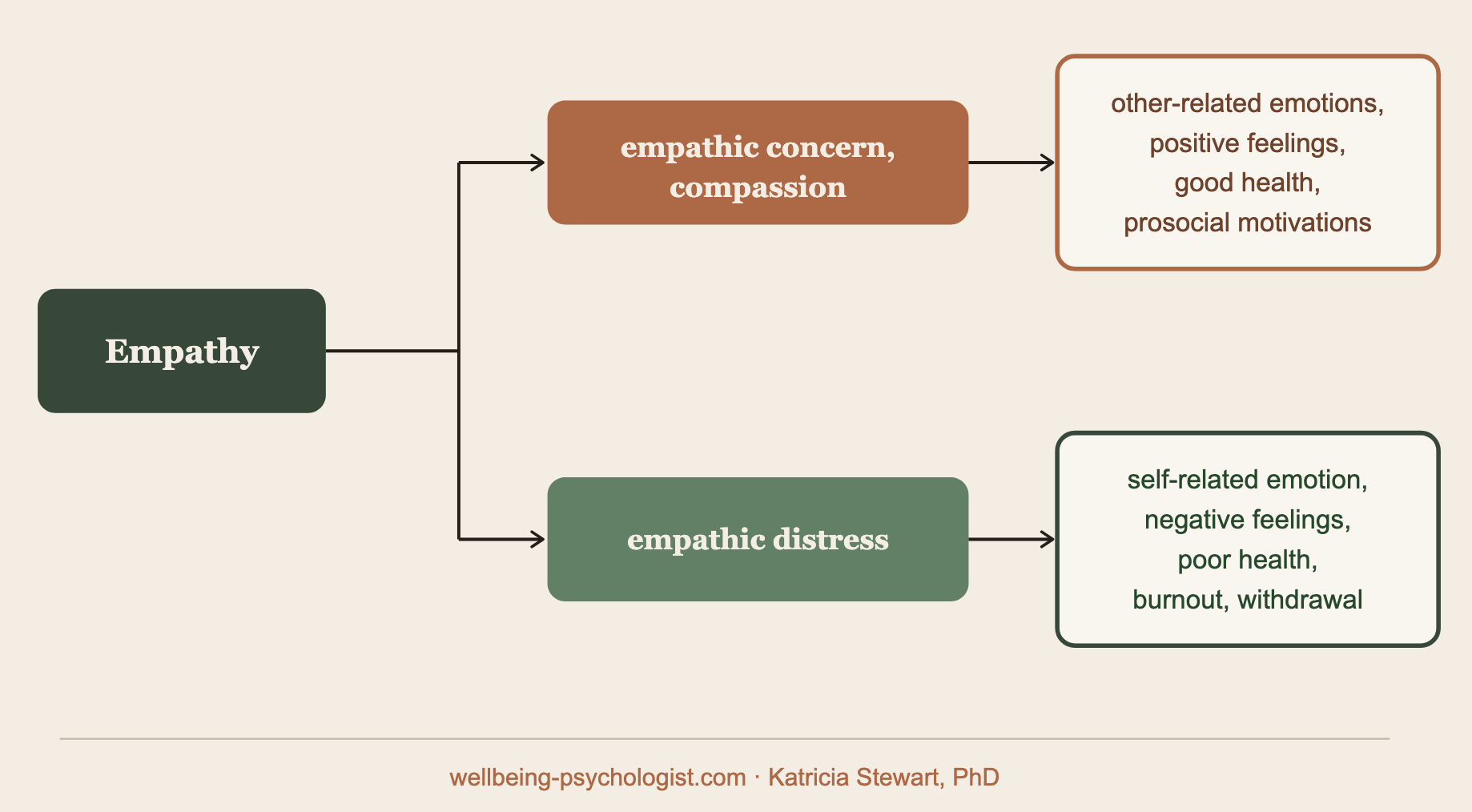
Empathy refers to our ability to take the perspective of and feel the emotions of another person. Empathy is the “mirroring or understanding of another's emotion.”
Compassion moves beyond empathy to include the desire to help. Empathy is feeling; compassion is action.
Altruism, on the other hand, is kind and selfless behavior. Altruism can be motivated by feelings of compassion, but we can also feel compassion without acting on it, and altruism can be motivated by feelings that aren’t compassion.
Sometimes we are afraid of compassion out of a misperception that it makes us “soft” and that people might take advantage of us if we are too compassionate, neither of which is true. Fighting fire with fire never works. Instead, compassion allows us to understand the humanity of others, and then to respond to their fire with humanity and creativity.
Empathy
Our ability to take the perspective of and feel the emotions of another person. With empathy, we join with the suffering of others, but we stop short of actually helping.
Compassion
When those feelings and thoughts of empathy include the desire to help. With compassion, we take a step away from the emotion of empathy and ask ourselves, “How can I help?” Compassion goes beyond feeling with the other to feeling for the other.
Four Steps of Compassion
The most well-studied techniques for cultivating compassion skills are found in mindfulness meditation programs. Even with short periods of compassion training, participants continue to feel empathy for the suffering of others, but they also gain the capacity to bypass or move through any distress and into positive emotions.
“Cultivating compassion goes beyond feeling more empathy and concern for others. It develops the strength to be with suffering, the courage to take compassionate action, and the resilience to recover from, or prevent burn-out.” –Dr. Sara Owens Woodard
Compassion involves a four-step process that is important to understand, as it points to where empathy fatigue can happen in our daily lives:
Identifying the suffering in another being (recognition)
Feeling or thinking what that must be like (empathy)
Connecting with your desire to alleviate that suffering
Taking action to alleviate that suffering (including internal actions or personal practices focused on coping in healthy ways when we feel like there’s nothing we can do)
When this process is seen through completion, we experience the uplifting and regenerative effects of compassion. However, many people get stuck at step 2, empathy, which is when we experience empathy fatigue and burnout.
Compassion Satisfaction
Compassion satisfaction refers to the positive effects that those in helping professions can derive from their work with people who are traumatized or suffering. It encompasses the pleasure derived from being able to do one’s work well and help others as well as contribute to the greater good of your community of society.
Benefits of Compassion
When we feel compassion, our heart rate slows down, we secrete oxytocin (the “bonding hormone”), and areas of the brain linked to empathy, caregiving, and feelings of pleasure activate – which contribute to us wanting to approach and care for others.
Compassion also enhances positive emotions in response to adverse situations. Because compassion generates positive emotions it counteracts the negative effects of empathy that can be elicited by experiencing others’ suffering.
Compassion cultivation and practice has numerous benefits, including increased happiness, calmness, acceptance, connection with others, and overall well-being (and increased compassion, of course). Compassion cultivation has also shown to decrease stress, anxiety, depression, chronic pain, empathy fatigue, and burnout.
Resources for Compassion
Learn more about the types of compassion: Taxonomy of Compassion.
Learn more about the benefits of compassion: https://greatergood.berkeley.edu/topic/compassion/definition#why-practice-compassion
Learn more about cultivating compassion: https://greatergood.berkeley.edu/topic/compassion/definition#how-cultivate-compassion
Practice 3: Building Relationships
Relationships are what makes us human. They are where we hurt and where we heal. Yet many of us never step back to question how we might intentionally nurture our existing relationships or build new ones. Below are a few suggestions to help you do just that. These are intentionally small or low-barrier suggestions — building relationships can feel daunting, but simple small steps get us there.
Practices for Building Relationships
Sprouting new relationships
If you’re trying to develop new relationships with people, here are a few starting points:
Join a class or group that interests you (pottery, hiking, golf, a book club).
Ask low barrier questions to get the conversation going: how they like to spend their time when the sun comes out, if they’ve seen a good tv show recently, what their favorite weekend breakfast food is.
Ask an acquaintance out for a friend date.
I once was in a Zoom (the video conferencing platform) group with some other women, only one of whom I knew well (she started the group). One of the other women and I happened to both log on before other people one week, and she mentioned that she just went through a breakup — turns out, so had I. So I very casually asked, “Want to grab dinner some time and talk about it together?” She said yes, and now years later we are great friends.
Nurturing existing relationships
Many people also have a goal of improving the relationships they already have. One approach is to focus on a different social connection every day for a week. It is so easy to get lost in the sauce of our lives and forget to reach out to the people who matter to us. Here are some small ways to ensure you keep those connections alive:
It can be a small 5-minute act like sparking a conversation with someone on public transportation, asking a coworker about his/her day, or even chatting to the barista at a coffee shop.
At least once this week, take a whole hour to connect with someone you care about — a friend who’s far away or a family member you haven’t talked to in a while.
Not sure what to say when you reach out?
To foster strong bonds and better relationships, try sharing good news or celebrating success with those you are close to (Siedlecki et al., 2014). And, make sure to listen deeply, respond supportively, and be happy for others when they share good news or personal successes with you! Responding enthusiastically to others – particularly in close or intimate relationships – fosters intimacy, well-being, and satisfaction in our relationships.
The key is that you must make and take the time needed to genuinely connect with another person.
At the end of the day, list the social connection you made and notice how you feel when you jot it down.
Taking our relationships deeper
Two books I highly recommend for supporting your relationship-building skills:
Talk: The Science of Conversation and the Art of Being Ourselves (2026) by Alison Wood Brooks
How to Know a Person: The Art of Seeing Others Deeply and Being Deeply Seen (2023) by David Brooks
A few other resources:
Practice 4: Community Engagement
Sometimes, what we’re looking for with relational well-being isn’t improved connections with those in our closest circle, but rather improved connections with our community. So how do we get involved – in meaningful ways – with our communities?
Identifying Opportunities for Community Engagement
What are the opportunities for involvement in your area?
Make it easy on yourself by looking for something physically in your area.
You’re more likely to go to whatever it is if it is close by (as opposed to driving an hour away).
Or maybe you’re afraid to go to something close by because you don’t want to run into someone you know. In that case, either (a) examine why you have that fear and whether it’s a fear that supports you or holds you back, and (b) look for something further away if needed, just make sure it is close enough that you’d actually go to it).
What opportunities resonate with your values?
To make involvement in our communities stick, it can help to have it tied to something we value. Think about social causes you may want to support.
For example: a friend of mine decided to join a tree-planting volunteer opportunity because she cares about the environment and wants to spend time outside.
What support do you need?
Think about groups that would support you.
Is there a women’s hiking group focused on body positivity, helping women feel safe outdoors, or supporting BIPOC folks in getting outside?
If you value time in nature, want support in spending more time in nature, but are held back for some reason, there’s probably a group for that!
You can still tie this one into your values, which can help it stick even better.
What can you create to offer others?
Maybe you’re not finding something in the above categories that resonates with you. Maybe you have an idea of something aligned with your values that you could offer others. This can be a great way to start and build community! If you’re not sure you have the organizing or advertising capacity for it, start small and reach out to someone who might be able to tag-team with you.
When I was in college, I had a couple friends over every now and then on a Sunday for yoga and pancakes. I wanted to do yoga with others, but I couldn't afford classes regularly and didn’t like the class environment. I also offered a social (and food!) aspect by making my friends pancakes afterwards. It can be as simple as that!
practice 5: Nurture your relationship with nature
While we often think of our relationships in terms of other people and our communities, we also have a relationship with the natural world that is an important part of our well-being. (See the Connect with Nature section of Mental-Emotional Well-Being for more on how connecting with nature benefits our well-being.)
Nature Connection Reflection Questions
What is the quality of your relationship with the natural world?
How much quality time do you spend in nature and exploring the natural world?
In what ways do you take care of the natural world you live in?
Notes on Community building
Connection Creates Communities
There are three main areas to successfully creating and maintaining communities. These are connection, openness, and belonging (Speer, P. W., et al., 2013). Connection links people together and forms the initial bonds for communal relationships. Openness is the starting foundation for communities to form and is required for one to join a community. Belonging is what keeps community participation going. Connection, openness, and belonging are key to creating and joining communities.
Connection:
Finding and forming communities can be a very similar process when getting started because they both rely on connection. Connection is the personal links one has to others in life. Stephen Jon Thompson explains the importance of connection in his TEDx talk titled,Creating a Community and Finding Purpose. In his talk, he explains that community is all about shared connections. He suggests starting by making friends with everyone. Much like networking, he sought to meet many new people and share conversations and activities thereby expanding his personal connections. These personal connections opened up many opportunities for him because as he puts it, “what my friends did, I did.” In creating connections with others, Thompson joined many communities and created his own vast community consisting of the many connections he strives to make.
Openness:
Joining and forming communities would not be possible without openness. It is difficult to form connections without being open to others and likewise if others are not open to you. Sometimes being open means getting out of your comfort zone. It means talking to strangers, trying new activities, or opening up yourself when someone invites you to connect with them. Thompson explains that his community had no borders and consists of all his connections. Being open to everyone may not be easy, but seeking to be inclusive is what led Thompson to explain that his success is a symptom of his community. What success are you looking for? What does your ideal community look like? If you are willing to be open with others you may find that community successes are open to you.
Belonging:
Openness is what allows connections to form and belonging is what strengthens those connections that form a community. According to Angela Damiani, belonging is the product of social architecture which can be shaped with three steps which she shares in her TEDx talk titled Chasing Belonging. The first part is empowerment. Empowerment is the reminder that people are individuals and we should support each other as such. The second part is seeking increased connections. This includes making connections with a broader culture outside our own and making efforts to be more inclusive. The third part is change mechanisms. This involves requesting changes and helping to make that change. The final piece Damiani shares is showing consistency in those three steps. She explains that trust is shared experience over time and consistently creating positive shared experiences contributes highly to belonging.
***
Communities form and expand because of the individuals that contribute to them. These contributions include connections between people which expand the horizons of successful communities. Showing openness and acceptance of others brings people together to join and participate in communities. Belonging keeps these connections alive and growing and is what most people look for and come to find by contributing to communities. Connection, openness, and belonging are the key to joining and forming communities.